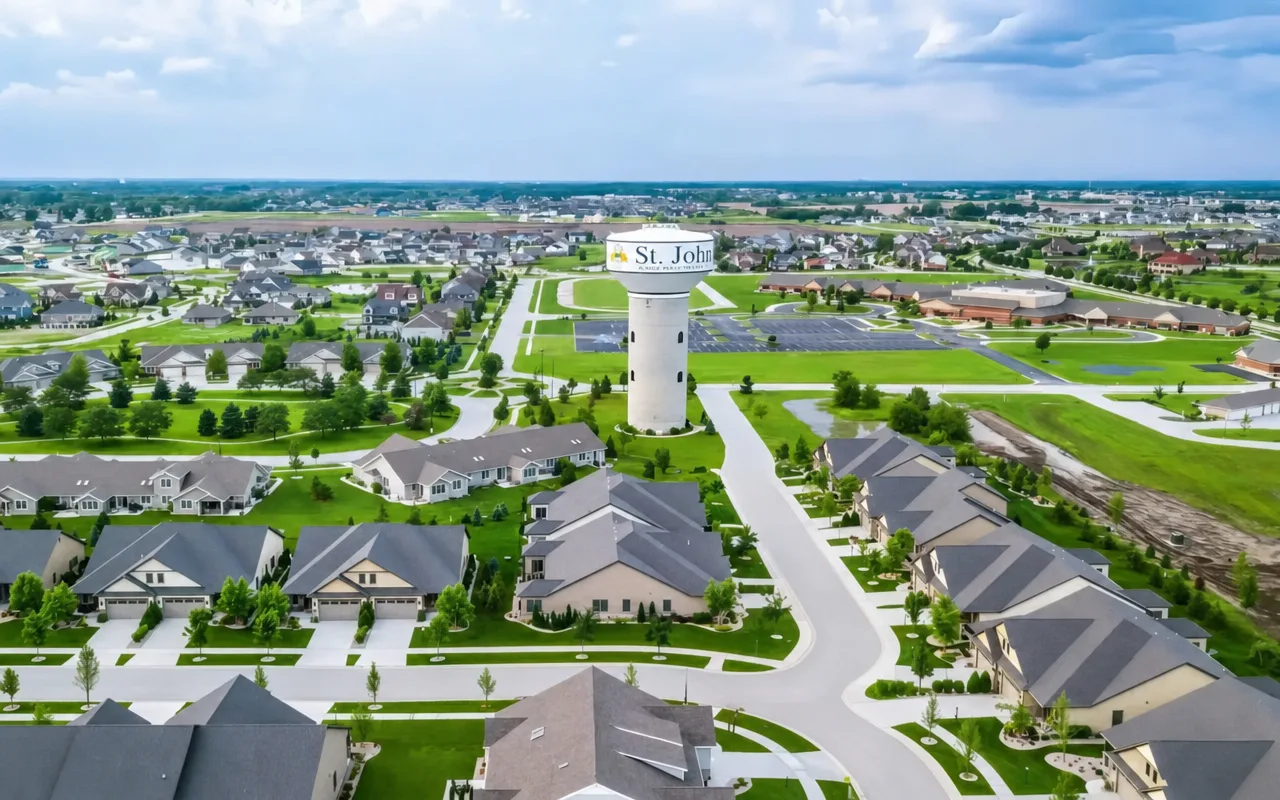
Living in St. John, Indiana
Real home prices, Lake Central schools, and a doable Chicago commute, from a lifelong local.
Real home prices, Lake Central schools, and a doable Chicago commute, from a lifelong local.
If you keep hearing St. John's name from Chicago friends who moved out, there is a reason: it is one of Lake County's fastest-growing towns, and almost every buyer who lands here describes the same feeling, big house, bigger lot, great schools, and a commute to the city that still works. This guide walks through the real numbers, home prices near $455K, the Lake Central district, the Wicker Avenue corridor, and the honest commute math, so you can decide if St. John is your town.
For most relocating families, the school district is the first question, and St. John's answer is a strong one. The Lake Central School Corporation covers the Tri-Town area of St. John, Schererville, and Dyer, and its single high school, Lake Central High School at 8400 Wicker Avenue in St. John, opened in 1966 and enrolls roughly 3,000 students. The high school offers AP courses, Project Lead The Way engineering and biomedical tracks, and a Gifted and Talented program, and the district has collected multiple College Success Awards since the 2018-19 school year. The district office is at 8260 Wicker Avenue, right in St. John, which tells you how central the town is to the school system.
Elementary and middle school students are served through the district's neighborhood schools, including Kolling Elementary and Hal E. Clark Middle School in the St. John area. My Northwest Indiana schools guide walks through how each district in Lake, Porter, and LaPorte counties lines up if you are comparing towns side by side.
St. John is about 30 to 35 miles from downtown Chicago. By car, plan on 45 to 60 minutes, with about 51 minutes a reasonable average off-peak. US-41, which runs through town as Wicker Avenue, connects to I-80/94, the Borman Expressway, and I-65 feeds in from the south, and the Indiana Toll Road (I-90) is the faster, pricier northern option for downtown-bound drivers. At rush hour the Borman is the Borman, so hybrid commuters plan around it.
South Shore Line Monon Corridor, about 5 to 6 miles away
There is no train platform in St. John yet, but the new Monon Corridor terminus at Munster/Dyer, which opened March 31, 2026, sits about 15 minutes from St. John's town center. Direct weekday rush-hour trains run from Munster/Dyer to Millennium Station in downtown Chicago in roughly 60 to 70 minutes, with other Monon trains shuttling to the main line at Hammond Gateway. A future extension to St. John has been discussed, but it is not built, so today the equation is: drive to the station, ride into the Loop.
The realistic match
If you are downtown every single day, the western towns like Munster and Dyer put you closer to the direct Monon trains. If you commute a few days a week, mostly by car, or your office is not downtown at all, St. John's extra few miles buy you a lot of house and lot for the money. It is one of the most popular answers for Chicago-area professionals who want the space more than the platform.
Fares on the South Shore Line run about $7.75 one-way from Hammond Gateway to Millennium Station, with the full station-by-station table on mysouthshoreline.com. My complete commuting guide breaks down every town's drive and rail times in detail.
St. John is not a bargain town by Lake County standards, it is a premium one, but you get concrete trade for the price. The median sale price in 2026 runs about $455,000 (Zillow, data through September 2026), with Redfin-derived figures around $448,000 for spring 2026 and average home values near $461,000, up about 2 percent year over year. Compare that with Lake County's overall median around $284,000, and you see exactly where the premium goes: bigger lots, newer builds, and the school district.
The inventory story matters too. St. John is one of the few towns in the county with an active pipeline of new construction, from move-in-ready specs to build-to-suit lots, alongside established subdivisions with mature trees and settled streets. Buyers coming from Chicagoland often notice the same thing: a quarter-acre or half-acre lot at a price that would buy a townhouse in the suburbs of Cook County. That combination, new inventory plus space, is the engine behind the town's growth.
Wicker Avenue, the local name for US-41 as it passes through town, is St. John's main street in the modern sense: a corridor of dining, coffee, and services that anchors daily life. Mornings start at Avgo Breakfast and Lunch, the town's beloved breakfast spot at 9321 Wicker Avenue. Lunch might mean Boyos Authentic Mexican Food or a slice from Rosati's, and evenings run to Livio's Restaurant or Sips & Stones Lounge and Eatery, all within a short drive along the corridor. When you want a bigger night out, Teibel's Family Restaurant in nearby Schererville has been a Region institution since 1949.
Outdoor life revolves around Prairie West Park, a roughly 12-acre park at 9359 W. Oakridge Drive with playgrounds, a pond, walking paths, and the town's celebrated holiday light display, plus Wicker Memorial Park on the St. John and Highland border, which brings athletic fields, a swimming pool, and the summer concert series at its Social Center. The community calendar is steady: the Gobble and Grub Festival in late November, Christmas in the Park at Prairie West Park from November 27 through January 1, and the town's Very Grinchy Christmas event in early December.
Before the cul-de-sacs, St. John was prairie. The town traces to 1837, when German immigrant John Hack settled land in what was called the Western Prairie, and the community grew around St. John's Church, the first church built in Lake County. A post office opened in 1846, and the Francis P. Keilman House, built for an early German settler around 1857, still stands and earned a spot on the National Register of Historic Places in 2013. That history is part of why St. John feels settled rather than strip-mall new, even as the construction crews keep busy.
St. John is at its best for growing families, commuters who drive a few days a week, and buyers who want new construction on real lots without leaving Lake County. It is less ideal if your daily office is downtown Chicago, where Munster and Dyer's direct Monon trains save you the drive-to-the-station leg, or if your budget tops out below the mid-$400s, where Schererville, Dyer, and Crown Point stretch further. My family neighborhoods comparison lines St. John up against its neighbors, and the St. John neighborhood guide has the quick-reference version.
Putting St. John in the bigger picture? My Moving to Northwest Indiana guide covers the commute, taxes, cost of living, and every town worth knowing. The cost of living comparison shows the real numbers, and if you are buying from out of state, my step-by-step remote buying guide walks the whole process. Want to know what a specific St. John subdivision is really like? Ask me directly, I live this market.
Quick answers about home prices, schools, and the commute for families considering Lake County's fastest-growing town.
In 2026, the median sale price in St. John sits in the low-to-mid $450,000s. Zillow's data through September 2026 puts the median sale price around $455,000 with an average home value near $461,000, and Redfin-derived data from spring 2026 shows a median near $448,000, up about 6% year over year. New construction in the town's active developments often lists higher than the resale median.
St. John is part of the Lake Central School Corporation, the district serving the Tri-Town communities of St. John, Schererville, and Dyer. Its one high school, Lake Central High School on Wicker Avenue in St. John, opened in 1966, enrolls roughly 3,000 students, and offers AP courses, Project Lead The Way, and a Gifted and Talented program. The district has earned multiple College Success Awards since 2018.
St. John sits about 30 to 35 miles from downtown Chicago, and the drive typically runs 45 to 60 minutes, with about 51 minutes a realistic average depending on traffic. Commuters use US-41 (Wicker Avenue), I-65, and I-80/94, the Borman Expressway. Rush hour in the Borman can stretch that, so the train becomes an attractive option for many households.
Not yet. The closest South Shore Line option is the new Munster/Dyer station on the Monon Corridor, about 5 to 6 miles from St. John's town center, roughly a 15-minute drive. That terminus opened March 31, 2026, and direct weekday rush-hour trains run from Munster/Dyer to Millennium Station in downtown Chicago in about 60 to 70 minutes. An extension to St. John has been discussed as a future phase, but it is not built.
Yes, and that is the town's whole identity. Spacious lots, newer developments, the Lake Central school district, community parks like Prairie West Park and Wicker Memorial Park, and a family-first calendar of events from the Gobble and Grub Festival to Christmas in the Park make it one of the most sought-after family communities in Lake County. Buyers from Chicagoland are a big part of the market.
New construction, Lake Central schools, and a commute that still works. I can help you find the St. John home, lot, or subdivision that fits your family and your budget.